

Lori Anderson Moseman’s chapbooks from above/ground press include: ignite (2026) and Whittle Gristle (2025) plus Okay? and Too Few Words (2023). Quietly Between, a 2022 poetry/photography collaboration, is available from A Viewing Space. Her experimental poetry collections include Darn (Delete Press, 2021) and Y (Operating System, 2019). For her earlier prose poems see Full Quiver (Propolis Press, 2015) and Flash Mob (Spuyten Duyvil, 2016). She lives on Kalapuya Ilihi, the traditional indigenous homeland of the Kalapuya people whose descendants are citizens of the Confederated Tribes of the Grand Ronde Community of Oregon and the Confederated Tribes of the Siletz Indians of Oregon.
You’ve now published four chapbooks with above/ground press. How do you see your work progressing between titles?
There is a palpable shift between the first two (Too Many Words and Okay?) and the recent two (whittle gristle and ignite). That shift is not “progress.” It is “just plain less.” The plain refers to stripped-down, non-lyrical language. Blame memory loss, hearing loss, slipping cognition. Perhaps my wandering expanses of Oregon’s tidal flats and Montana’s undulating grasslands leads to a no-nonsense directness. By resting with volcanos and buffalos, am I learning to steady rumbling power? As my 90+-year-old aunt’s dementia progresses, she teaches me fortitude (her word not mine). Absence of language can be a quieting presence? I’m trying to give more attention to what is just, but I’m still not doing enough.
Or, the shift in writing style could result from page size. The last two chapbooks were written after my Covid work in Quietly Between. In that collaboration with Brad Vogler, Sarah Green and Megan Kaminski, I wrote poems to fit on 4” by 6” postcards. Less words. More unsaid. The poems in whittle gristle and ignite were sculpted to fit above/ground’s 5” by 7” page.
But, let’s not ignore how unnerved I am by oligarchs and their puppet felon king(s). Whittle gristle addresses imperialism via artworks showcased in Necroarchivos de las Americas. I wrote those poems while U.S. citizens elected 45 to be president 47. That’s why I study artists who document and denounce violence (Castro Arias, Camnizter, José Galindo, Lozano-Hemmer, Margolles, Gómez-Peña, Salcedo, Tatera, Jarpa). To reflect on their materiality of mourning, I turn to these writers: Abel, Barghouti, Bök, Oswald, Zamora. My new chapbook, ignite, was written early in 47’s current reign of terror. As gunboat diplomacy became overt war mongering, his legislators and judges dutifully dismantled of our already crumbling democracy. Am I saying this too simplistically?
If you compare writing in these chapbooks to that in my book Y (Operating Systems, 2018), you’ll see I still had a sense of humor back when 45 was first elected. My political rants used linguistic pyrotechnics and kooky diagrams. A hula hoop was my extended metaphor. My high-pitched panic and robot-phobia made audiences laugh. Who is laughing now? Now, folks are reading The Nerd Reich: Silicon Valley Fascism and the War on Democracy. Can there ever be a peaceful transfer of power again? Poems in Y were worried about water rights, food security, free speech, immigrants’ rights, racial justice, fair trade, alternative energy. Now, 47’s atrocities jeopardize these global living conditions at a terrifying rate.
Visual artists give me hope. I have never had a writing practice without them. The chapbook ignite zeros in on Chiharu Shiota. Her hands and heart forge connection across borders. Her forms and material speak like poems. You can learn about her creative process in her conversation with writer Yoko Tawada (Chiharu Shiota: Threads of Life). Tawada: “Tell me what you are thinking as you as you string threads of your installation together?” Shiota: “I paint with thread. I paint with thread all over the space. Every time, the thread gets tangled… . When I touch thread and feel the tangle in my heart, it is certainly not put into words.” Tawada: “I myself always use words to see and think about things. When I look at works using thread, I initially think restraint, but it is the opposite—not ‘liberation’ but rather a feeling of being tied together, connected.”
These days, like all days before, I write to connect. Art “play” is vital too. This year, I’m painting vowels. I’m gathering stones from a tidal zones then wrapping them in bookbinder’s thread. I am writing postcards to swing states.
Were each of these titles deliberately composed as chapbook-sized units or part of a larger-book length manuscripts?
The only whittle gristle started as (and will remain) a chapbook. It was compiled in response to a temporal exhibit.
The new chapbook, ignite, might grow into a book. This January, in Kanazawa, I was privileged to see Kiyoshi Awazu’s “E” paintings (Earth, Environment, Energy, End) in the exhibit, “The Possibilities of the Written Word.” His work hung on a wall opposite Kōji Kakinuma’s massive calligraphy, Phoenix. I hope to capture the sensation of standing between those works. To that end, I have been rereading Kazuaki Tanahashi’s Brush Mind: he proclaims the power of a broken brush making a single line: “Every brush stroke must be decisive … don’t touch up or white out a trace of your brush … there is no going back. It’s just like life.”
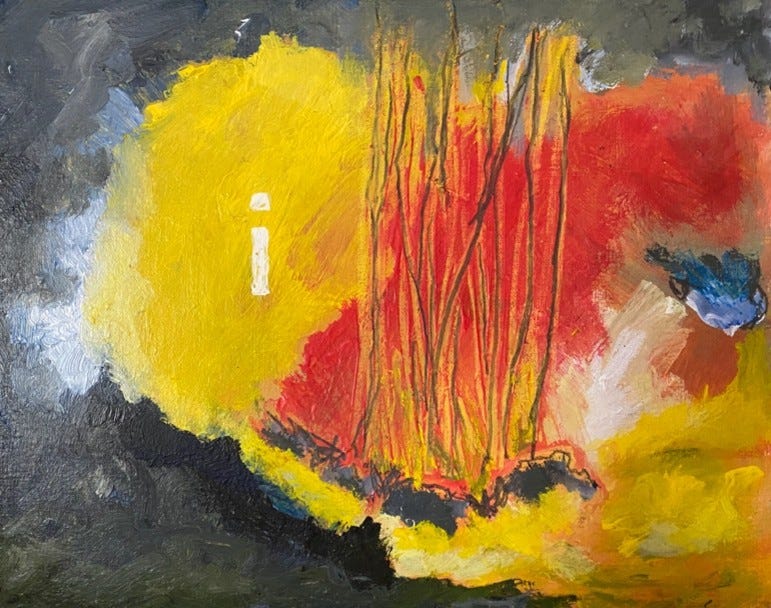
My messy cover art, “i,” for ignite rests on a little plexiglass shelf over my writing desk; kitty-corner from it is a postcard invitation to the James Lavadour: Land of Origin exhibit at The University of Oregon. Lavadour creates huge grids of immersive mountain-scapes; each painting pushes/pulls pigment the way printmakers do. Only recently did I notice how my “i” painting mimics Lavadour’s colors and shapes. His bold palette comes from his being present for sunrise daily—a practice I used for “(t)here now soon new” in Quietly Between. Perhaps I will renew that practice by watching tonight’s blood moon lunar eclipse.
Both Too Many Words and Okay were part of a book-length manuscript circulating contests. rob, when you asked to see a chapbook for potential publication, I split that manuscript in three: two parts became above/ground chapbooks; a third part, a hybrid text/artist collaboration, had already been published online in Talon. “Jarring Bits” combines encaustic work by Sheila Goloborotko with fragments of conversations I had with my mother while she was in hospice and with the poet Marthe Reed before she suddenly died. I’d love to see “Jarring Bits” be published as a book in combination with “insistence, teeth” another collaboration with Sheila Goloborotko. When Marthe Reed edited the Ecopoethos (eco || poesis || ethos) issue of Dusie in 2014, she included “insistence, teeth.” A question Marthe posed in her preface informs all my writing: “At the interstices of ecological zones, species, cities, nations, bodies, those permeable borders separating ‘us’ from ‘them,’ human from other-than-human, insider from outsider, the vulnerable from the powerful, how might we configure our understanding, encounter the unbounded condition having neither center nor margin?”
How do you see your chapbooks in terms of your larger work?
All my work doesn’t stray very far from previous work. Take the title and painting of ignite. The fire they are transports me back to the poem “I Am Talking Fast to My Sister on How to Sharpen an Axe” in my first book Cultivating Excess (1992). That pseudo-pantoum enacts my chopping fire breaks in Los Padres National Forest back in the summer of 1977. Currently, the Timber Fire is burning there now in the burn scar of the Soberanes Fire (2016) which overlaps the burn scar of the Basin Fire (2008). Cycles repeat. Frequency and severity change. Words still calm the suffering?
Rob, a few years ago, you published some prose poems of mine in Touch The Donkey. They were part of an 8” by 9” handsewn manuscript Fathom. Bits from Fathom and my four above/ground chapbooks expanded into a 7” by 11” handsewn book, JuxtaPropulsionboat-is-to-umbrella-as-gun-is-not. My dear friend, Meredith Stricker, dared me to expand JuxtaPropulsion: “make it more encyclopedic; make it double-space, an inch thick, with diagrams, drawings and photos.” So, I am going to do that. I trust Meredith’s instincts. In addition to being an exquisite poet, she’s part of an architectural team called “Visual Poetry Studio Architecture.” Fire-ready structures they built in the aforementioned burn scars were just tested by the current Timber Fire around Big Sur. Buildings designed by Visual Poetry Studio Architecture survive.
In expanding JuxtaPropulsion into tidbits, my compendium, I might even abandon the book form altogether. Imagine returning early experiments with hypertext (circa 1996-2002). Or, imagine a box of 6” by 10” cards readers can shuffle-n-stuff into accordion holders—little paper pockets that let readers sequence the tidbits themselves. Here’s my current inspiration: Claudia Rankine’s Triage, Eleni Sikelianos’ Memory Rehearsal, Lawarence Kramer’s Experiencing Sound: The sensation of Being, Czeslaw Milosz’s Road-side Dog, Stacy Szymaszek’s Essay, Kate Siklosi’s Selvage, Divya Victor’s Kith, C.D. Wright’s The Poet, the Lion, Talking Pictures, El Farolito, a Wedding in St. Roch, the Big Box Store, the Warp in the Mirror, Spring, Midnights, Fire & All.
Your attentions always seem so thoughtfully, thoroughly detailed. You give the sense of so many of your projects in terms of response. Is this how you would categorize your work? What brought you to the point of working these kinds of approach, these response-works?
Yep, you could sum up my poetics with one word: “cite.” Here’s nine possible inciting incidents:
1) I am an oldest child.
2) There were psychic and corporeal consequences in my home if I wasn’t “thoughtful and thorough” with school work or chores or eating or talking or or or… .
3) A competitive athlete since 5th grade (my parents were P.E. teachers), my body found pleasure in rigorous, prescribed workouts. I was always responding to a coach.
4) I rebelled by going to church. No one in my family went to church. There, I found hermeneutics.
5) I was trained in technical journalism and scientific report writing.
6) My poetry training was academic: Iowa Writers Workshop, iEAR Integrated Electronic Arts, and Doctor of Arts in Writing and Teaching.
7) I spent 23 years teaching freshman composition. “Read this then look at this. Respond.”
8) I spent 10 years publishing poets and artist who respond to each other’s work.
9) I never daydream of becoming a mystic . . . although I did take dervish lessons.
I love that you mention Road-side Dog, which has actually been an important collection for me as well. What is it about that particular work that prompted your thinking?
Short answer: Meredith Stricker thought Milosz’s prose blocks (part poem, part aphorism, part anecdote) could help me transform JuxtaPropulsion into a more encyclopedic tidbids, my compendium. Mostly, Milosz helps me understand humans’ unending cycle of despots. Check out pages 99-101 (“Tanglewood” plus “A Strategy” plus “The Law of the Earth”).
Long answer: The first Milosz lines I memorized were from Belles in Winter: “If I am responsible / it is not for everything…. / my ships never left the pond to sail the sea…. / books were already written. Ideas thoroughly discussed. / The ax was put to the tree.” His wryness is all the more biting because I entered poetry after earning a degree in forestry. I had not read all the books others had. I had not thoroughly discussed ideas that others had. But, I certainly had put an axe to a tree. I reach for Roadside Dog at unpredictable intervals. I bought my copy on April 19, 2005 at 5:44 p.m. in NYC’s Skakespeare & Company. The sale slip bookmarks Milosz’s “Alexandria”: “…I have lived to the epoch when a word does not refer to a thing, for instance a tree, but to a text on a tree, which text was begotten by a text on a tree, and so on.” As I said, you could sum-up my poetics with the word “cite.”
I love melding Milosz’s cynicism (“a word does not refer to a thing”) with Alice Oswald’s celebration of “thingness.” Have you listened to her 2021 lecture Professor of Poetry Lecture, “On Behalf of a Pebble?” I revisit it constantly. She shows how poets “cope with the matter of Matter.” After dropping a pebble in the Ainu string instrument, tonkori, Oswald strings together pebbles from a Ponge poem and a Herbert poem. She lets audiences read those texts. Then, leaving the page, she introduces Ainu epic poet Hiraga Etenoa, circa 1930, and her Song of the Fire Goddess. Oswald warns us, “She who floats up in sparks/ she who floats up in ciders” appears after we hear the sounds of “a needle, six silver wiping sticks, a single sedge stalk, clogs, gloves, two metal fans, clothes with heavy hems and a bundle of ornaments.” Before Oswald performs Etenoa’s poem, she primes listeners by citing Ponge: “Fire has a system … first all the flames move in one direction. One can only compare the progress of fire to an animal; it has to leave one place before occupying another… .”
Poetry, as sound carvings, should ignite so Oswald suggests as she shifts from Etenoa to Homer. Here’s a passage from Oswald’s Nobody: “Whereupon the water turned its cloak / and shook itself into flame and burnt itself fur / … and then an old mottled man full of mood-swings / forgetting his name and twisting his hands / denying and distorting and thinking ill of everything / snapped himself into sticks and burst into leaves / which fell back down again as water….” An oath we make with all beings to transform?
In her interview about Nobody with David Naimon, Oswald makes the claim “Americans put thinking in their poems.” I think I read Milosz because he was in exile not just from another continent but from another century. I turn to Road-side Dog for his “old” thinking. And to see how he, at 85 or 90, valued his writing practice. I savor his magic tricks. See “That”: “It looks as if that, ready, formed in every detail, waited nearby, at a hand’s stretching and I had caught it. I would not have drawn the thing out of the nothingness all around, but taken, as if from a shelf, and object already existing.”
This is a compelling interview! I am looking forward to reading Lori Anderson Moseman's new chapbook.